Spotting Microaggressions on the Dancefloor
They may be subtle. But they still hurt.
Nightlife is built on freedom: freedom to dance, dress up, flirt, sweat, express yourself, disappear into the music, and feel part of something bigger than your everyday life. But that freedom only works when people feel socially safe.
At The SoSaf Club, we believe safety creates the scene. Not in a boring, restrictive, “don’t do anything fun” way. The opposite. When people feel respected, seen, and protected, they can relax deeper into the night. They dance more freely. They connect more honestly. They stay longer, trust the space more, and look out for each other.
That’s why microaggressions matter.
They can look small from the outside. A comment. A joke. A look. A repeated “accidental” touch. A person ignoring someone’s discomfort because “it’s just dancing.” But these moments can build up quickly, especially for people who already move through the world being questioned, sexualised, excluded, misgendered, stereotyped, or made to feel like they don’t fully belong.
Microaggressions may be subtle, but they still hurt. And on a crowded dancefloor, where bodies are close, communication is messy, and the music is loud, subtle harm can easily be missed.
So let’s get nerdy about it.
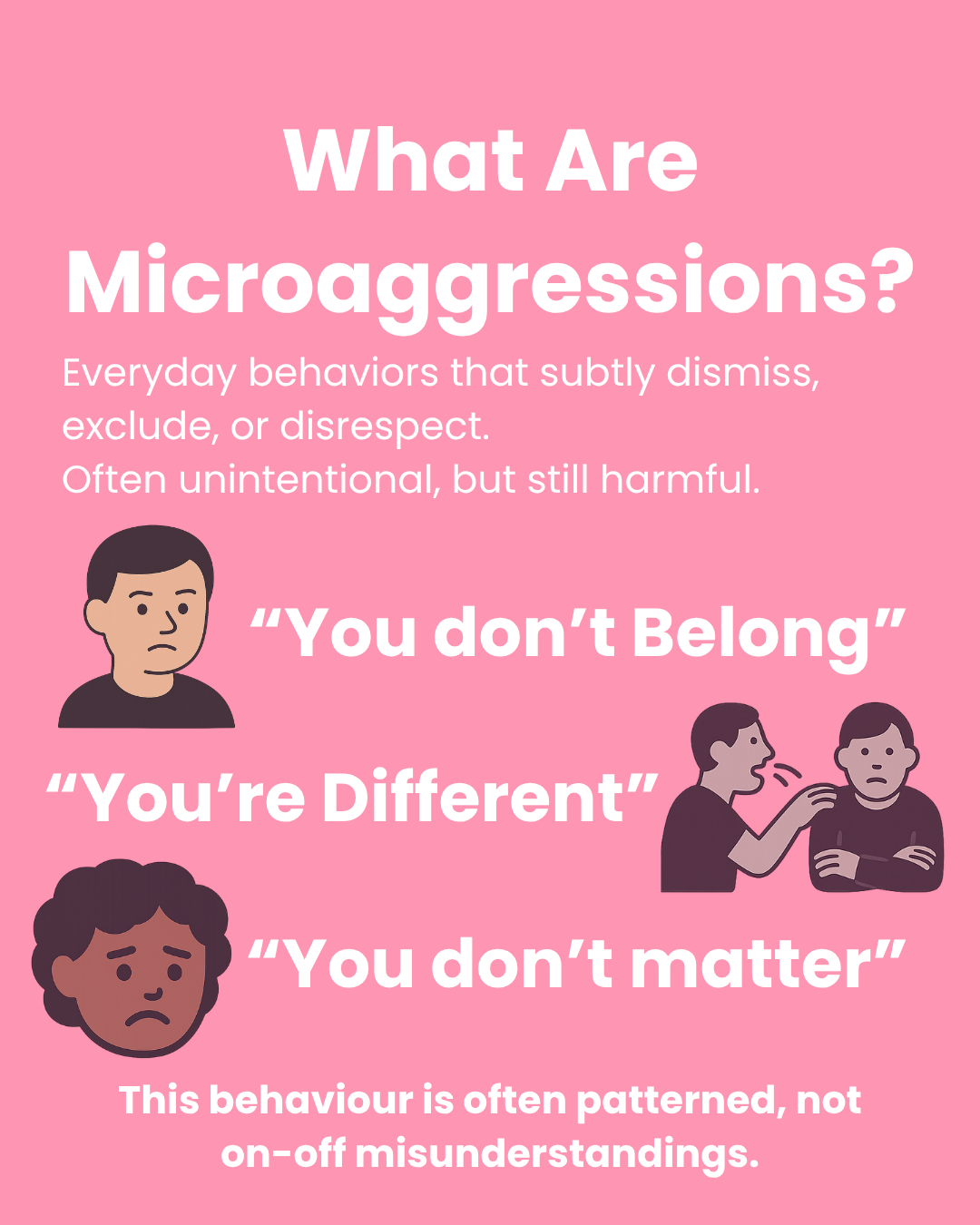
Microaggressions are everyday behaviours, comments, assumptions, or actions that subtly dismiss, exclude, stereotype, or disrespect someone.
They are often unintentional. That does not mean they are harmless.
A microaggression can send messages like:
- “You don’t belong here.”
- “You are different in a way I get to comment on.”
- “Your boundaries matter less.”
- “Your identity is up for debate.”
- “Your discomfort is not important.”
One awkward misunderstanding is not always a microaggression. Context matters. But microaggressions are often patterned. They repeat. They show up in familiar ways. And that repetition is what makes them exhausting.
For example, one person mispronouncing your name once might be a mistake. A whole night of people making jokes about your name, your accent, your gender expression, your body, your dancing, or your “vibe” starts to become something else.
In nightlife, these moments can be brushed off because the atmosphere is supposed to be fun. But “fun” should not mean people have to swallow discomfort to keep the mood light.
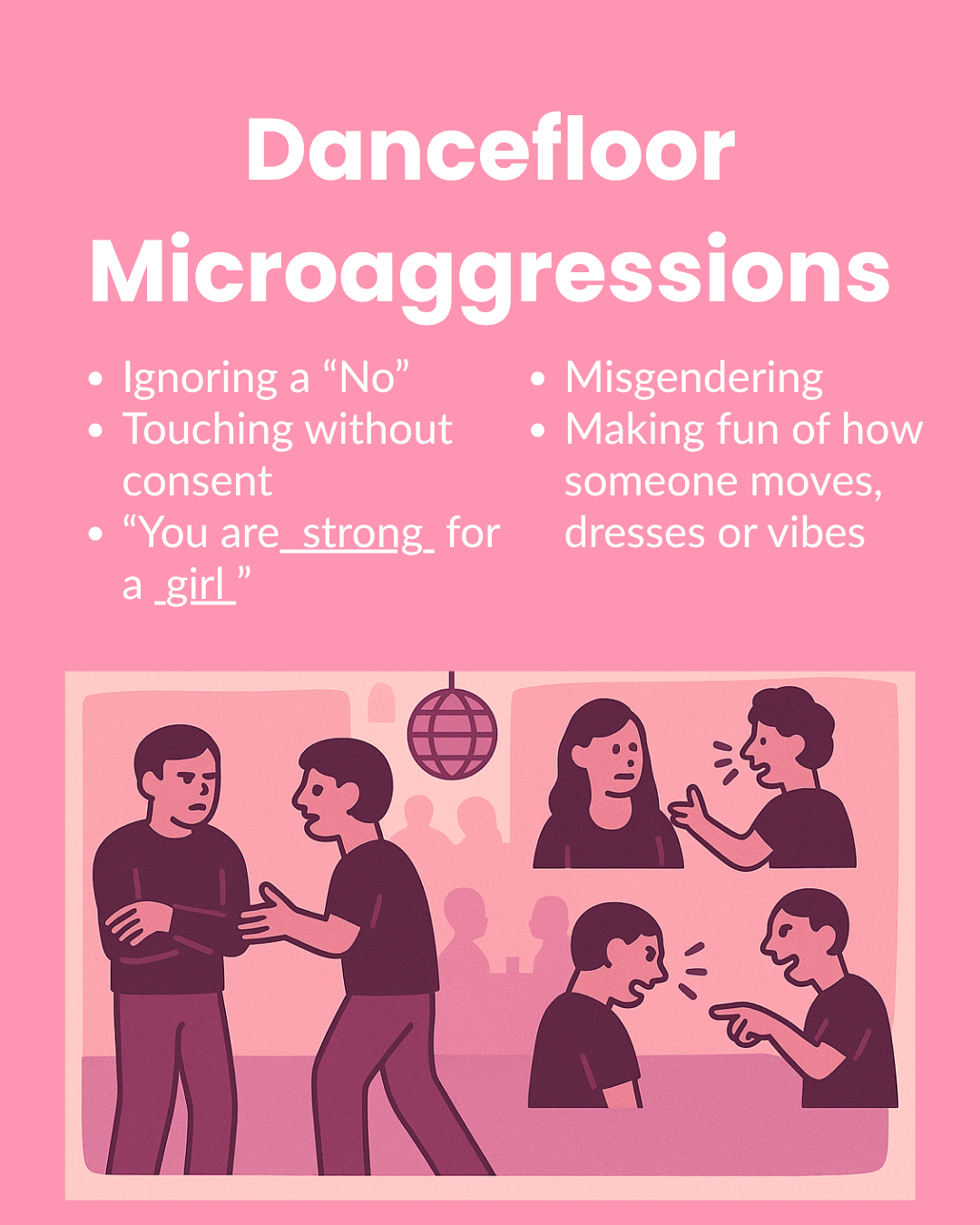
On the dancefloor, microaggressions can show up in obvious and less obvious ways.
They can sound like:
- “You’re strong for a girl.”
- “But where are you really from?”
- “You’re too pretty to be trans.”
- “I thought people like you didn’t come to parties like this.”
- “Relax, it was just a joke.”
- “You’re being dramatic.”
- “I didn’t mean it like that.”
- “You don’t look queer.”
They can look like:
- Misgendering someone after being corrected.
- Making fun of how someone dances, dresses, or expresses themselves.
- Staring at someone because they look “different.”
- Treating someone as exotic, intimidating, fragile, or available based on assumptions.
- Repeatedly invading someone’s space after they move away.
- Ignoring a “no” because the setting is loud, crowded, or flirtatious.
- Touching someone without consent and pretending it was accidental.
- Copying or mocking someone’s movement, accent, clothing, or cultural expression.
Some of these examples are more than “micro.” Touching without consent, ignoring a no, or repeatedly following someone around can become serious boundary-crossing behaviour. But they are included here because they are often normalised in nightlife as “just part of the night.”
That normalisation is exactly the problem.
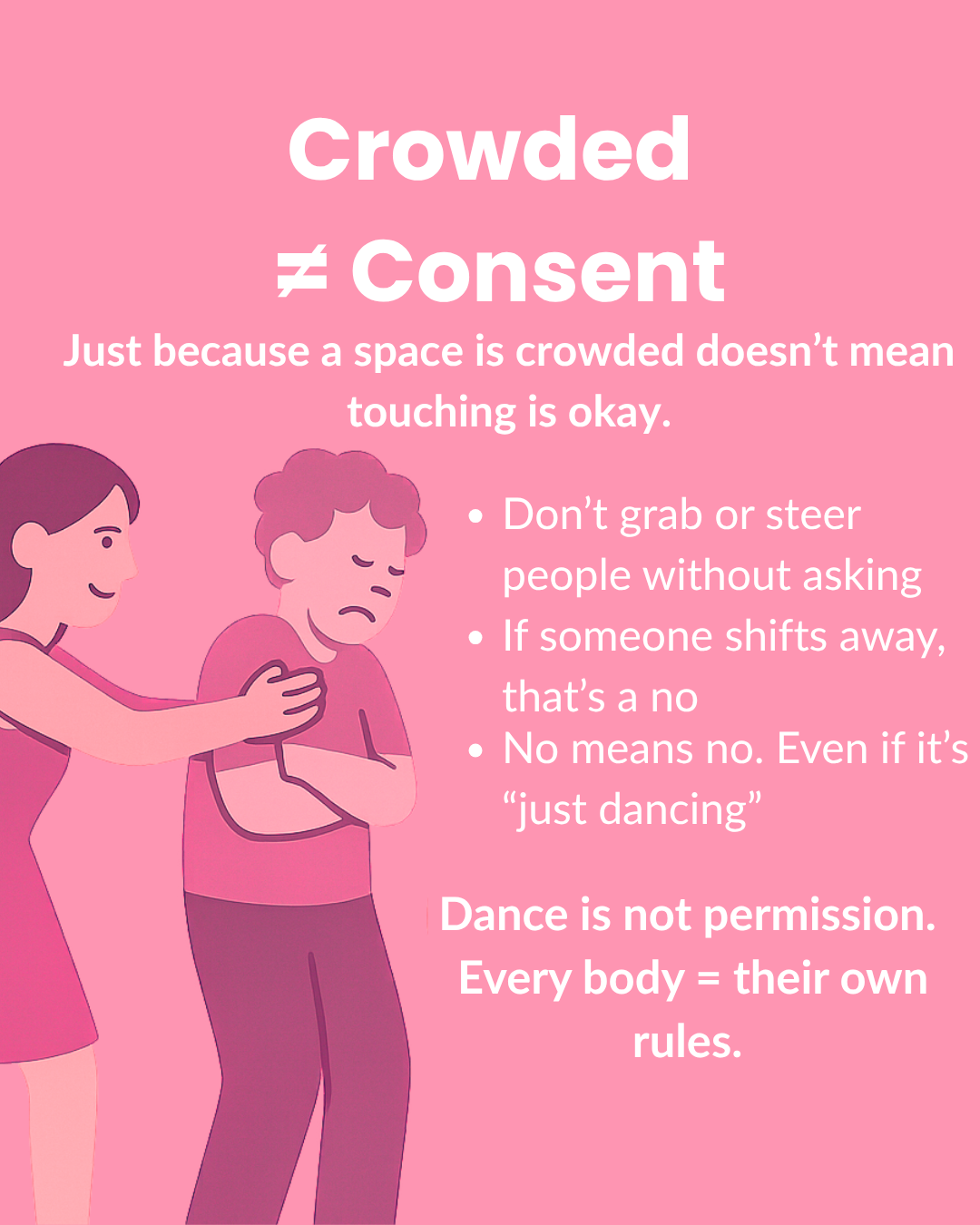
A packed dancefloor can make things blurry. People bump into each other. Someone steps on your shoe. A shoulder brushes past. Not every touch is intentional.
But crowded does not mean consent disappears.
There is a big difference between accidentally bumping into someone and using the crowd as an excuse to touch, grab, grind, steer, or corner them.
Dance is not permission. A smile is not permission. A sexy outfit is not permission. Being in a club is not permission. Being high, drunk, flirty, or expressive is not permission.
Every body has its own rules.
That means:
- Don’t grab someone’s waist to move past them.
- Don’t steer someone by their hips, shoulders, or lower back without asking.
- Don’t keep dancing closer when someone has moved away.
- Don’t assume eye contact means invitation.
- Don’t treat someone’s body like part of the atmosphere.
- If someone says no, stop.
- If someone freezes, stiffens, turns away, or creates distance, stop.
- If someone’s friends pull them away, respect that.
A clear “no” is a no. But body language can also be a no.
Someone shifting away is information. Someone becoming quiet is information. Someone no longer matching the energy is information. Someone fake-laughing while looking uncomfortable is information.
In a socially safe scene, we pay attention to those signals.
Why subtle harm is easy to miss
Microaggressions are tricky because they often hide inside “normal” social behaviour.
A person might say, “I was just joking.”
They might say, “I didn’t mean it like that.”
They might say, “It’s not that deep.”
They might say, “But everyone was laughing.”
And sometimes people around them believe it, because the vibe still looks fine from the outside.
But someone can laugh and still feel unsafe. Someone can stay polite because they don’t want conflict. Someone can freeze instead of fight back. Someone can pretend everything is fine because they don’t know if anyone will believe them.
This is especially true in nightlife, where there is pressure to “not ruin the vibe.”
But here’s the thing: the vibe is already ruined if someone feels small, unsafe, mocked, touched without consent, or pushed out of their own night.
Social safety asks us to notice what is happening beneath the surface.
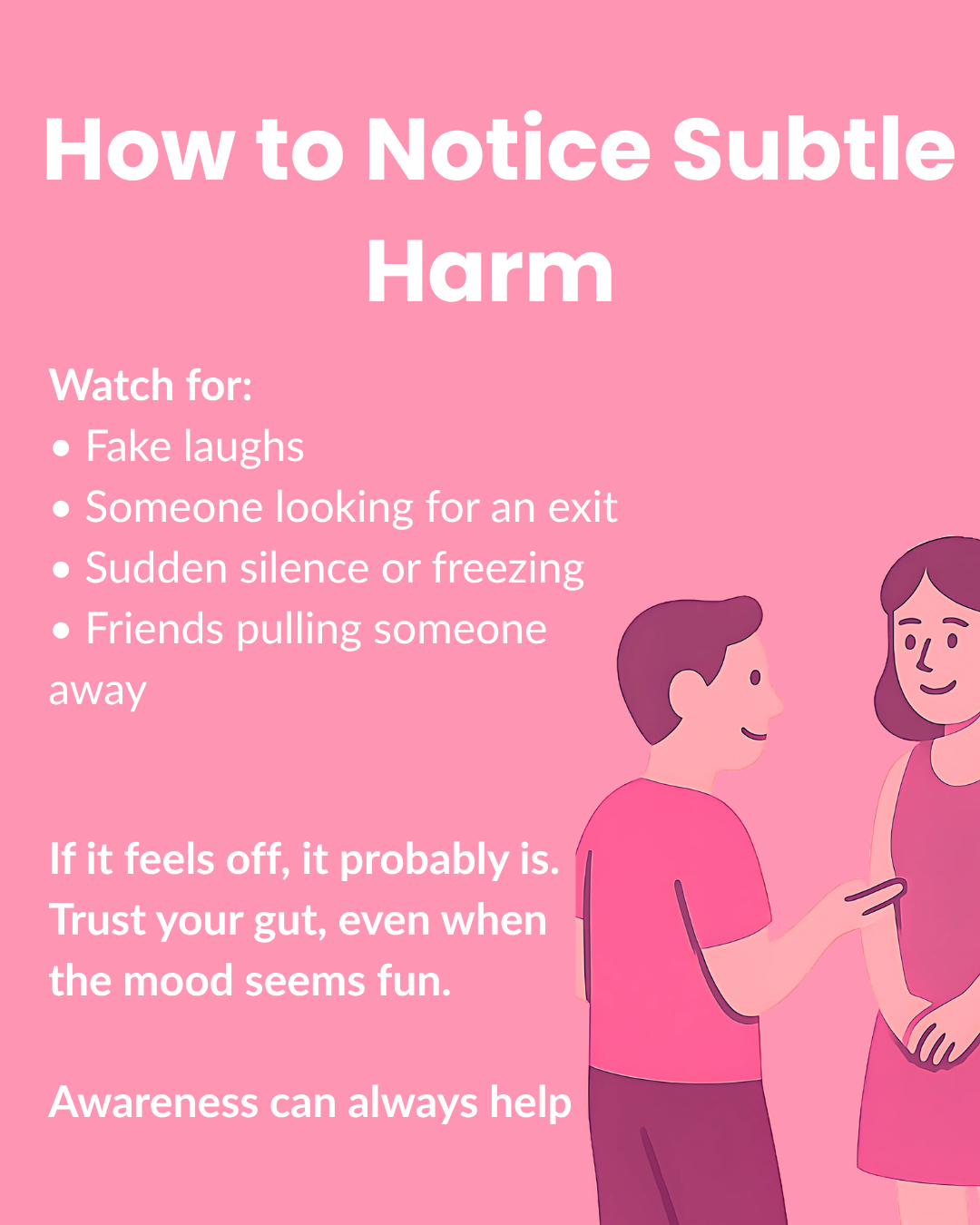
You do not need to be a trained psychologist to notice when something feels off. You just need to pay attention.
Watch for:
- Fake laughs.
- Forced smiles.
- Someone suddenly going quiet.
- Someone freezing or becoming stiff.
- Someone looking around for an exit.
- Someone repeatedly moving away.
- Friends stepping in or pulling someone away.
- A person being talked over, mocked, cornered, or followed.
- Someone seeming “stuck” in an interaction they are not enjoying.
Trust your gut.
If the mood seems fun but one person looks uncomfortable, take that seriously. You don’t need to diagnose the situation perfectly. You don’t need to know everyone’s identity, history, or intention. You can simply create a small shift.
That shift can protect someone’s night.
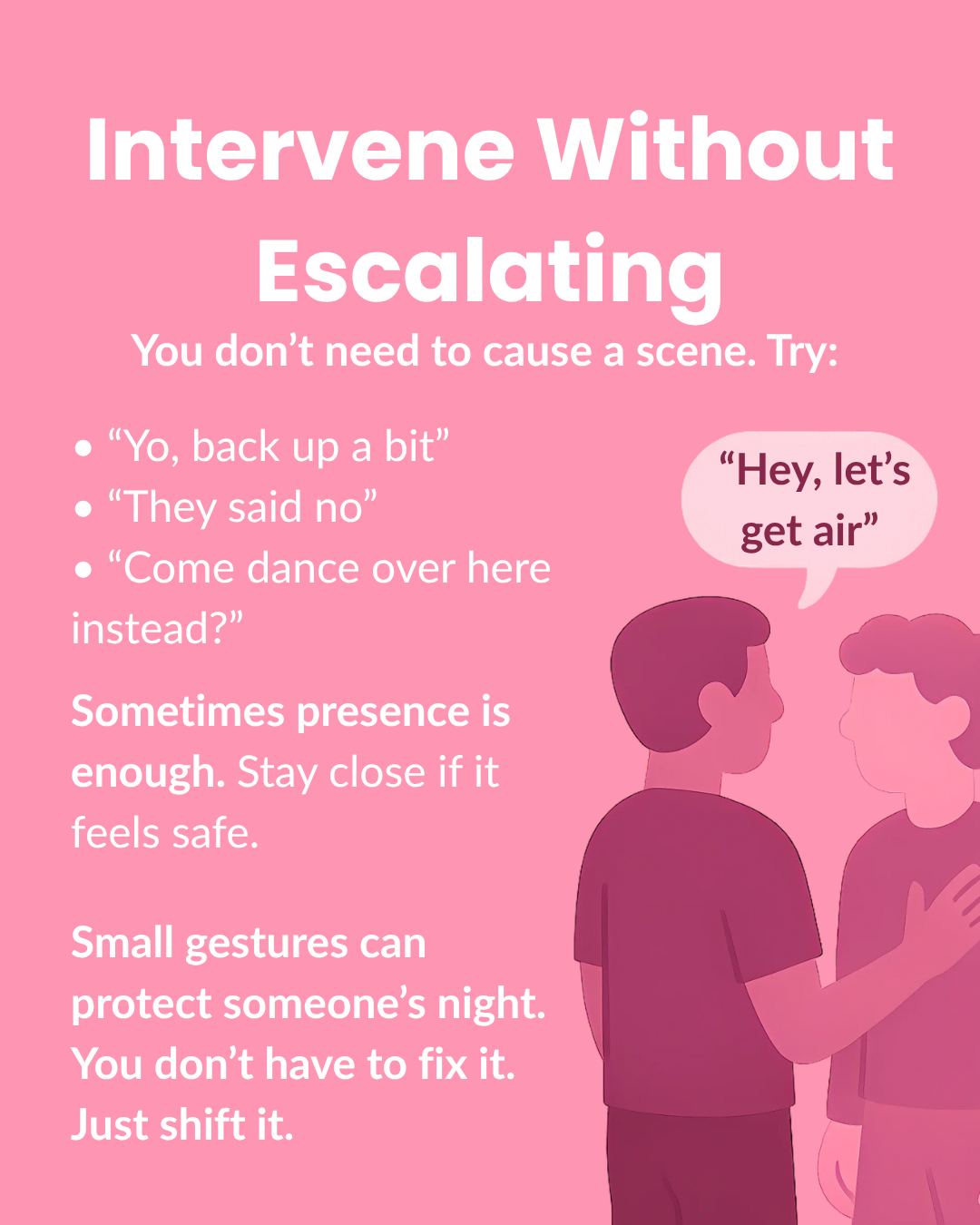
A lot of people hesitate to step in because they imagine intervention has to be dramatic. They think they need to confront someone loudly, call someone out, or create a scene.
Sometimes direct action is needed, especially if someone is in danger. But often, small interventions work best.
You can interrupt the moment without escalating it.
Try simple phrases like:
- “Yo, back up a bit.”
- “They said no.”
- “Give them some space.”
- “Come dance over here with us.”
- “Hey, let’s get some air.”
- “I’m going to grab water, come with me?”
- “Are you okay?”
- “Do you want to stay here or move somewhere else?”
- “Do you want me to get awareness?”
You can also use your presence. Stand nearby. Make eye contact with the person who seems uncomfortable. Offer an exit. Create a buffer with your body if it feels safe. Ask a friend to come with you. Get an awareness team member, host, bartender, security, or first aid if needed.
You don’t have to fix the entire situation. Sometimes you just need to shift it.
A small interruption can give someone enough space to breathe, leave, say no, find their friends, or ask for help.
The “safe one” role
Being the safe one does not mean being perfect. It does not mean becoming the dancefloor police. It does not mean assuming everyone needs rescuing.
It means being aware of the people around you.
The safe one notices when a joke lands badly.
The safe one respects a no the first time.
The safe one checks in without making it about themselves.
The safe one does not laugh along when someone is being mocked.
The safe one helps friends leave uncomfortable interactions.
The safe one knows when to call awareness or staff.
The safe one can apologise when they get it wrong.
This is the heart of social safety: small choices, repeated often, by many people.
That is how a scene changes.
If someone calls you in
Sometimes, you might be the person who caused harm without meaning to.
That can feel uncomfortable. Most people want to see themselves as kind, respectful, and safe. So when someone says, “That comment was not okay,” or “You misgendered me,” or “Please don’t touch me,” the instinct might be to defend yourself.
Try not to.
Instead, pause.
You can say:
- “Thank you for telling me.”
- “I’m sorry. I’ll stop.”
- “You’re right, I shouldn’t have said that.”
- “Thanks for correcting me.”
- “I’ll do better.”
Then actually change the behaviour.
A good apology does not need a long explanation. In a club setting, the most respectful thing is often simple: acknowledge it, stop doing it, and give the person space.
Intent matters, but impact matters too.
For awareness teams, staff, and organisers
For people working in nightlife, microaggressions are part of social safety. They may not always look like an “incident” at first, but they can shape whether people feel welcome in a space.
Awareness teams and staff can support by:
- Taking subtle discomfort seriously.
- Not waiting until something becomes extreme.
- Believing people when they say something felt off.
- Offering options instead of taking over.
- Creating exits from uncomfortable interactions.
- Using inclusive language.
- Respecting pronouns and names.
- Watching for repeated behaviour from the same person.
- Communicating with door staff, bar staff, security, and floor teams.
- Making it clear that “it was just a joke” is not a free pass.
The goal is not to punish every awkward moment. The goal is to build a culture where people are accountable, boundaries are normal, and support is easy to access.
A socially safe venue is not one where nothing ever happens. It is one where people know what to do when something does.
Protecting the vibe means protecting each other
There is a myth that calling out subtle harm ruins the atmosphere.
But ignoring it ruins the atmosphere for the person experiencing it.
A good dancefloor is not just about sound systems, lights, DJs, or programming. It is about trust. It is about the shared agreement that we can be wild without being careless. Free without being invasive. Playful without being disrespectful.
Microaggressions repeat, and they hurt. But awareness can repeat too. Care can repeat. Small interventions can repeat. Better habits can repeat.
That is how we protect the vibe.
Not by pretending harm does not happen, but by noticing earlier, responding gently, and being brave enough to shift the moment.
Subtle stuff matters.
So do we.
Be gentle. Be brave. Be part of The SoSaf Club.
Be the safe one. Pass it on.
@thesosafclub